Serial Correlation
How it's calculated
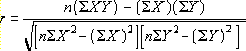
The Serial Correlation of the results of a test are measured using Pearson's product moment correlation coefficient function and by offsetting the results by 1 against themselves.
The Pearson product moment correlation coefficient (r) is found by solving for this formula:
How you can verify the calculation
You can verify the results produced by the back tester by doing the following:
- Take the Strategy PL CSV file produced during the testing and load it into Excel.
- Find the P/L column and at the bottom of this column enter the PEARSON(array1, array2) function.
- Replace the array1 parameter with the range in the P/L column but don't include the last item.
- Replace the array2 parameter with the range in the P/L column but don't include the first item.
What it means
The serial correlation value will be a value between -1 and 1. A value of 1 means perfect positive correlation and a value of -1 means perfect negative correlation. A value of 0 means no correlation.
High positive correlation (at least .25) generally suggests that big wins are seldom followed by big losses and vice versa. Negative correlation readings (below -.25) imply that big losses tend to be followed by big wins and vice versa.
How can we profit from this?
If there appears to be negative correlation and the system has just suffered a large loss, we can expect a large win and would therefore have more contracts on than we ordinarily would. If this trade proves to be a loss, it will most likely not be a large loss (due to the negative correlation).
If there appears to be positive correlation and the system has just suffered its first loss then this is suggestive of more losses to come and so contract size would be reduced or the system would be paper traded until a winning trade is encountered.
Further reading
If this subject interests you then we can recommend that you read more about this in The Mathematics of Money Management: Risk Analysis Techniques for Traders by Ralph Vince. A number of his ideas were used in the back testing system that we developed.
See also: Z-Score