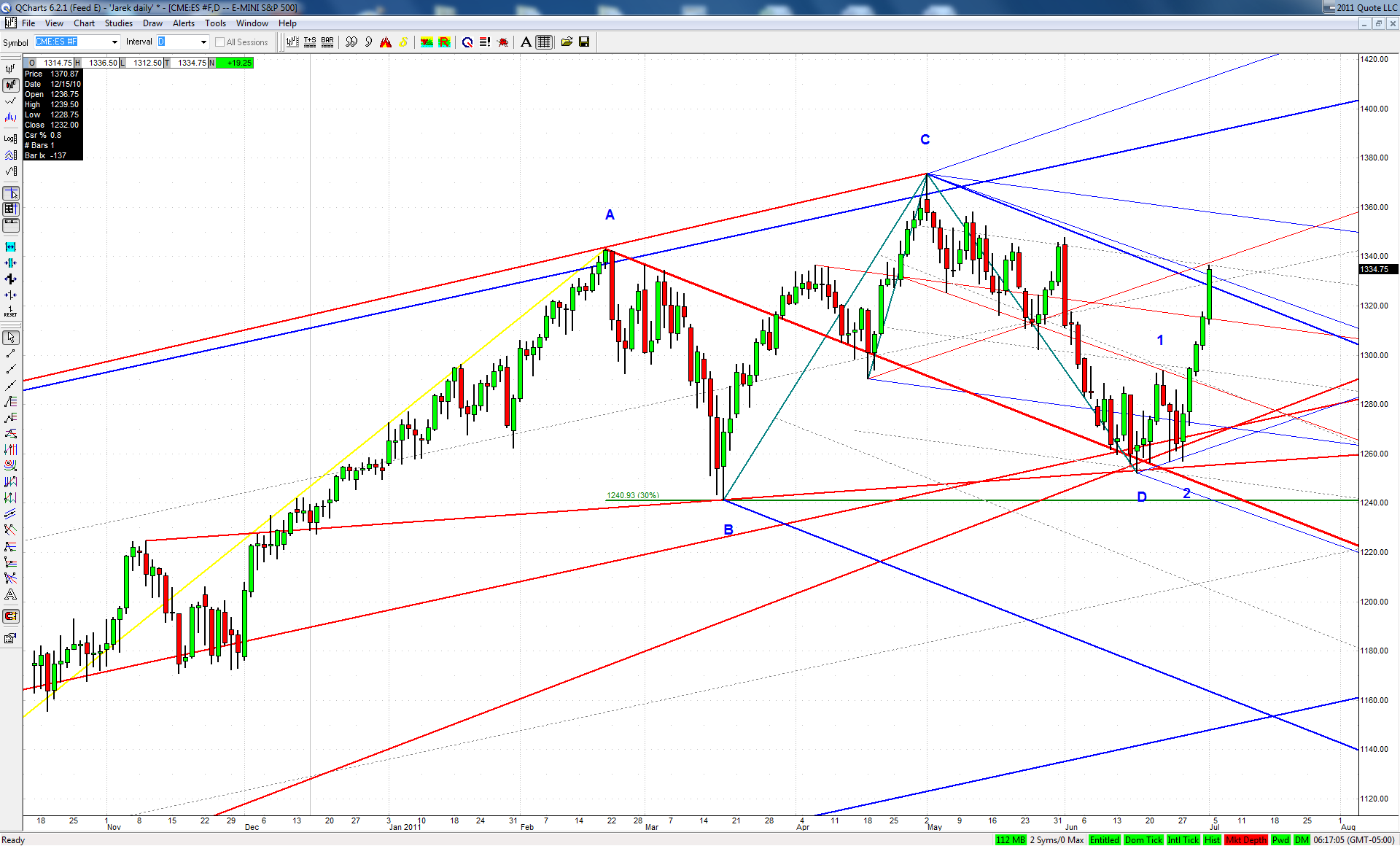
So we are in advance, which statistically happens once in a decade and there are some lines in the current area, but who said, we can't go for something even bigger than that this time around?
Somewhere in the coming week I'll disappear for more than 2 weeks for my first holidays this year, so you'll have a chance to rest from me for some time
JI
jimkane
Rep: 3,058
Posts: 33,089
Wow, that goes back over seven years! That was also right before Trade Management was released. If I recall correctly, that was during a time when I was in Scott's chat room a lot, and I was working on a plan to scale some out on the first pop and get the stop moved up right after that. I've since given up on that approach, looking to do more of what I explained in Trade Management. That's the refinement I am currently showing students. Keep in mind, though, intraday trading is somewhat different, since it has a usual 'range' for the day, and it has time constraints such that a trade taken near the end of the day may have room to run, but not before the close of that session of trading.
So, I've additionally modified the approach when doing short-term intraday trading. But for any swing trade or higher setups, I lean towards what was shown in Trade Management, with a lot of modifications and refinements in the last seven years. I show a lot of this to current students. I'm no longer in a position to write any more books to explain the evolution of my trading, and since I sometimes spend months and months on trade management with a student, there is no way I can post a few posts and explain all the refinements and nuances. Take a look at this post here for a little bit more detail:
http://www.mypivots.com/board/topic/5935/5/forex-trading/#83081
Originally posted by fib21
Jim it was posted on the forum a few years back taken from www.kanetrading.com free commentary from Feb 5th 2004.
Originally posted by jimkane
fib21, I'll be happy to answer that, but first can you tell me where that is quoted from? I don't have quite the same viewpoint now, although it is very similar, and I want to get a handle on where I was at, at that time, for perspective, before I answer.
Originally posted by fib21
Jim since I'm pretty new to the forum and need to catch up with the rest I have been reading through much of the trading discussions and I found something you wrote years back and I wanted to know if the few paragraphs below still basically describes your trade management style.
"If I call my potential trade areas correctly and wait for confirmation, I almost always get a 'pop' out of the gate. If I scale out of part of my trade on that first thrust, I can move my stop up at that time, or shortly after that. I'm now in a no lose situation, with 'no lose' defined as breakeven, very small loss, or very small winner, barring a market shock event at that instant".
This is where I want to be. I'm in, and my 'theoretical' risk is essentially gone. Check, fold, check… Then some percentage of these trades will take off and I'm in. That's where all the money comes from, in my 'Trading Plan'. In 'the old days' I had big targets, the targets that I laid out based on if the trade 'worked'. I then held firm to my stop, and got stopped out at a reasonable sized loss.
The problem was, I got stopped out a lot. I hit the big ones because I was in, but the 'small' losses just added up to more than the winners. I had a favorable reward/risk, but the winning percentage just wasn't enough to be net positive. I never was able to get the winning percentage high enough to overcome all the stop outs. I used to focus all my time on improving that winning percentage
Then I started to develop what is now the Kane Trading methodology. Now I have few losses to make up. I have a lot of breakevens, a lot of tiny losses (by comparison to a full stop out loss), and a lot of small winners. Then I have a few trades (on a percentage basis) that I really catch. It's not glamorous, but it's the only style that I've really found that I can work with.
FI
fib21
Rep: 0
Posts: 40
Jim that makes perfect sense. In the end everybody needs to formulate their own individual trade maangement plan based on things such as:
1. What swing one is trying to catch
2. The behavior of the issue being traded (choppy, smooth)
3. The traded time frame
4. Holding period (day or overnight)
5. Behavior after entry (interpretation of what is happening)
the list goes on......
1. What swing one is trying to catch
2. The behavior of the issue being traded (choppy, smooth)
3. The traded time frame
4. Holding period (day or overnight)
5. Behavior after entry (interpretation of what is happening)
the list goes on......
JI
jimkane
Rep: 3,058
Posts: 33,089
I knew that rally was something epic. Turns out it was the sharpest rally since 1644! You read that right, not 1944, 1-6-44!
http://www.zerohedge.com/article/guest-post-sharpest-rally-1644