I spent more than a year studying the books, making the notes and creating my trading plan. I'm still a beginner and have much to learn but I decided to post some of my setups. I hope it will help me to increase my level of experience. Feel free to comment those setups - I'll appreciate any useful advice.
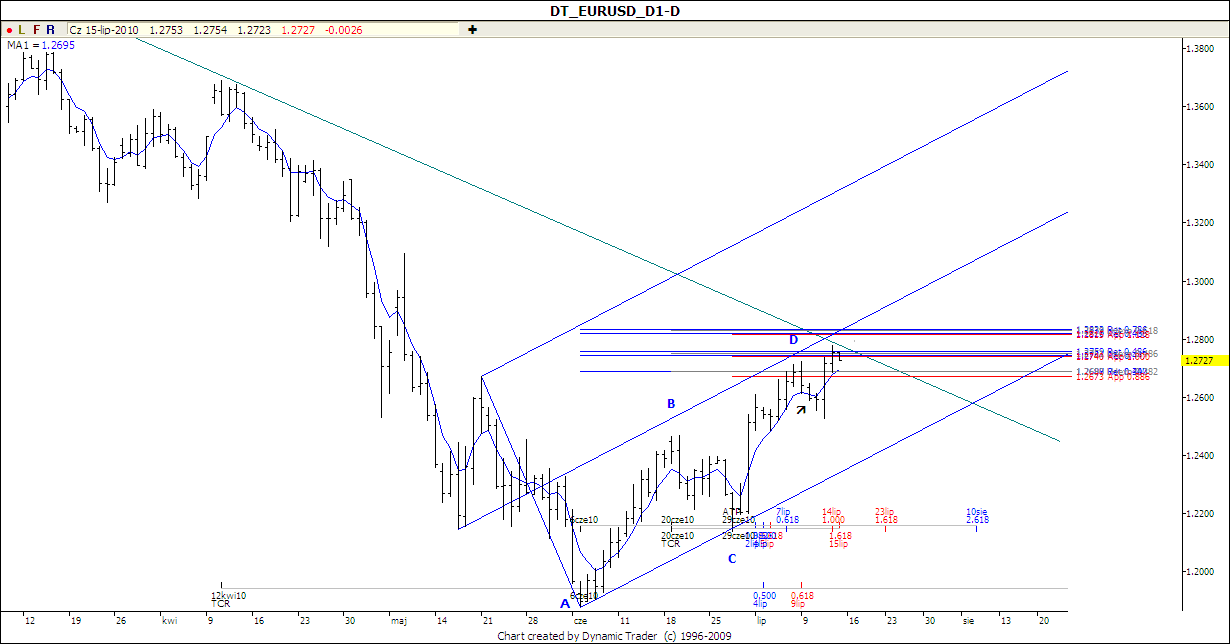
Setup #001: EUR/USD, 2D, Standard ABCD
I entered the trade on the bar pointed by the arrow. Right now I'm taking some heat right now but my stop loss put above the 2nd grouping hasn't been hit yet. I decided to stay and see how this trade will turn out.
TX
tx_ches
Rep: -10
Posts: 514
Jim's Trade Mgm book divides stops into stages such as first thrust, nether region, trailing stop.
After the first thrust line has been reached (you have marked that line based on averages for first thrusts), you can move your stop from your PTA area to a feasible technical area. The book gave examples of using the retrace zone of .618 to .786.
If you have moved your initial stop and then price comes back all the way to your PTA, you are likely stopped out. It's called trading. You re-evaluate and decide whether to try again or to pass.
Personally, I will usually try again. Some of the stocks I trade can get an almost 100% retrace so I don't always use the retrace zone mentioned above but just keep my stop below the PTA even after the first thrust. As always, what works for me and what worked for Jim at the time he wrote his book could be totally different than what works for anyone else.
And don't forget some of the behavior that can happen around price at the (prior) C point for some of the abcd patterns when the trade is looking like it is working for you.
Originally posted by marcin.lisiecki
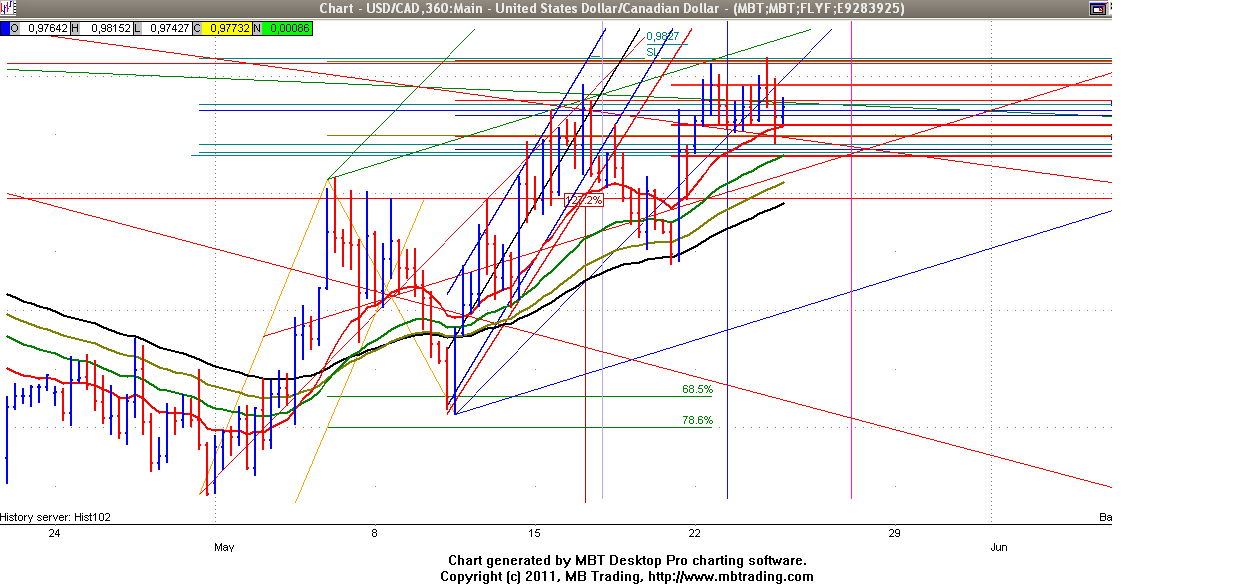
AUD/USD, USD/CAD: After my triggers activated I entered the trades. But after the first thrust, the price goes against my positions and retests my PTA. What do you usually do in situations like that?
MA
marcin.lisiecki
Rep: 0
Posts: 28
Thank you, tx_ches. I didn't move my stop in both of those trades. My stops are below / above PTA so I'm still holding those positions. I'll see what happens later.
MA
MarcinO
Rep: 67
Posts: 5,506
If I decide to move stop loss I usually use .886 retracement level. I'm not an experienced trader but found it useful in FX.
If you are interested in AUD pairs I've just placed a potential set-up in trading discussion topic
http://www.mypivots.com/board/topic/6715/-1/trading-discussion-week-of-5-23-11-to-5-27-11
If you are interested in AUD pairs I've just placed a potential set-up in trading discussion topic
http://www.mypivots.com/board/topic/6715/-1/trading-discussion-week-of-5-23-11-to-5-27-11
MA
MarcinO
Rep: 67
Posts: 5,506
The link was wrong. Sorry for making a mess.
This one is correct:
http://www.mypivots.com/board/topic/6715/7/trading-discussion-week-of-5-23-11-to-5-27-11
This one is correct:
http://www.mypivots.com/board/topic/6715/7/trading-discussion-week-of-5-23-11-to-5-27-11
JI
jimkane
Rep: 3,058
Posts: 33,089
Ah, the old time factor. Meaning, I have so little time... After the trading day today, and the long post I just did to finish off all the posts I made, I'm spent. But, alas, this topic needs my comments. It is very complex, and I sometimes spend months working one-on-one with a student just on management and expansion of what is in the Trade Management book. If I tried to explain much in here I would just get carried away, as I usually do.
Nonetheless, I am going to try to come back later (tonight, tomorrow, this week, who knows) and at least add some of my thoughts on this. There are serious clues in the price action to look at, and application of the techniques I discuss in the books is not that simple, with many qualifying conditions. This is why I spend months on it, going over endless examples with a student. In the case here neither of the examples had first thrusts by my definition, so the mentioned technique is not applicable. Try to ponder that until I get back...
MA
marcin.lisiecki
Rep: 0
Posts: 28
I just can tell that from my own perspective that trade management concepts are the hardest to grasp. I think one of the reasons is because there are many nuances that come from the experience and it's almost impossible to describe all of them in detail. That's why I have to go past the boundaries of confusion for the whole picture to become clearer.
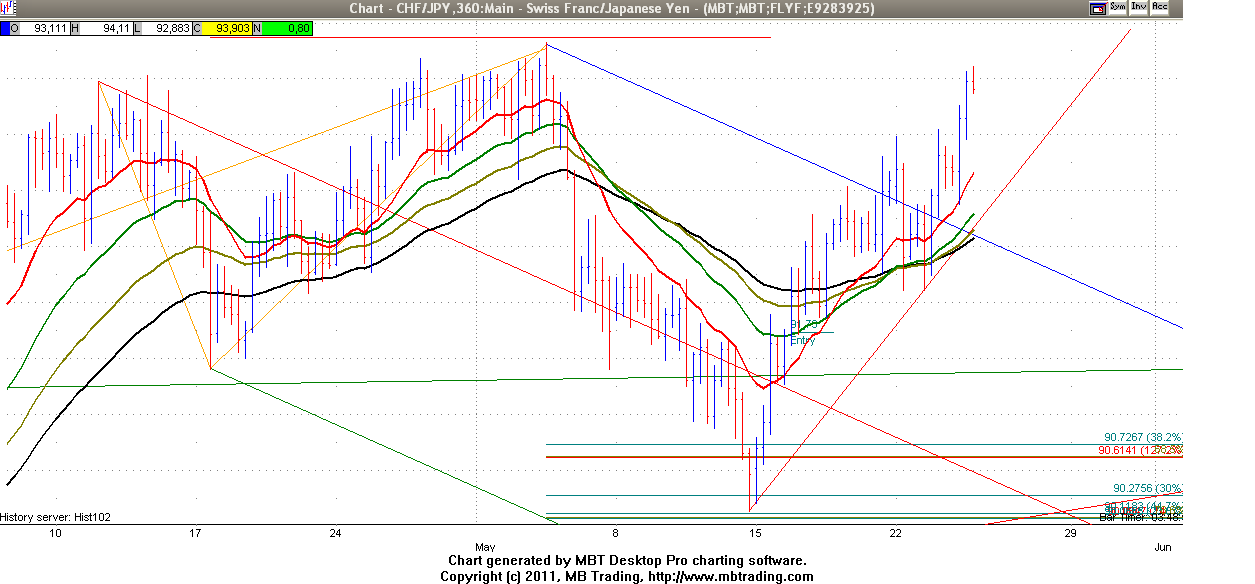
On CHF/JPY trade, that is still in play, there's something I think may be the first thrust followed by a correction and a second thrust that is forming right now. Please correct me if I'm wrong.
If I'm correct, I will use few EMA's on the entry TF to close parts of the trade. However, I don't like that they are a bit far away from the price action at this moment.
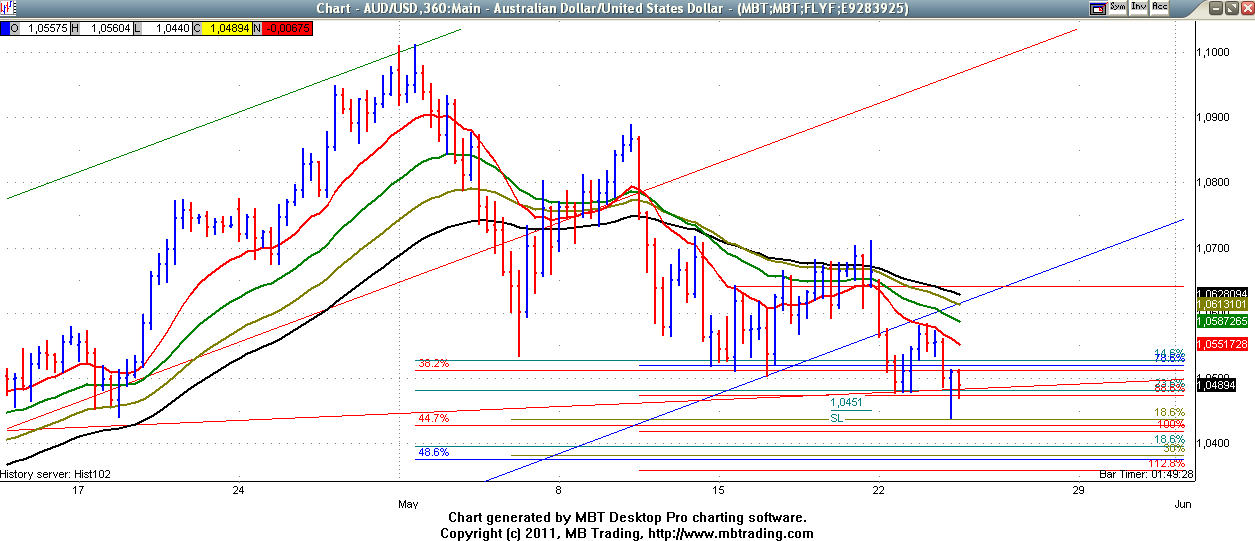
My AUD/USD trade has been closed with a SL:
USD/CAD trade is still in play. The price action rolled over, violated the second grouping, but the SL placed above the second grouping wasn't hit. I'll see what happens later.
JI
jimkane
Rep: 3,058
Posts: 33,089
Exactly. Except, for me, it's more like check, fold, check, check, fold, fold, check, cah-ching!
Originally posted by Duane
Check, check, check, check, bet.
JI
jimkane
Rep: 3,058
Posts: 33,089
This question, and what the methodology provides, is just so far beyond what can be done in a forum, or even in books. That's why it is really a mentoring question. Sorry for all those that frustrates, and sorry my style of development of material isn't 'simple'. It is what it is. One can't get mad at Einstein because his work was complex, and that he couldn't explain it in two paragraphs. (No, I'm not comparing myself or my work to Einstein, just making a point about complex material.)
Nonetheless, I'll give a 'simplified' overview, since I said I would. In Trade Management I covered the first thrust concept using one technique of simply looking at previous first thrusts an issue did, and using that value to get an idea where it may thrust to. I also covered a second concept of using a ratio of my stop, added to the low (or high, depending on the direction of the play). I wanted to see them hit the same area. Two techniques, one area, a confluence. Same as always, confluences.
The issue with using previous first thrusts is one of degree of swing. This is more than I can explain here, but as you look at waves, be them Elliott counted, or any form of looking at waves, you see different degrees of swing. A wave move subdivides, and it has waves. Each level is a different degree of swing. I look at my skills and within my skill set I feel I have strengths and weaknesses. One of my strengths, I think, is my use and understanding of timeframes. In line with that is also my ability to understand degrees of swing and frequency.
Now, what thrusts are of the 'right' degree of swing for a first thrust for any particular setup? That's the key. I am looking for a first thrust of a specific degree. You can look at a chart, drop way down in timeframe, and see it make a tiny little push up, and it may look significant, but the degree is way too small for the information I am trying to extract from it. The usefulness for me. Hence, I came up with various techniques to guide my eye to the right area, to the right degree.
At the level of experience I am at now, I no longer need these guides. I can sense the correct degree of swing, the correct first thrust, when I see it. But, until that time, I relied on techniques I developed, ones I show to mentor students. We spend sometimes months on this. I have four additional techniques I show. Two are primary approaches I start with, and then two more come in later, for various reasons, when other skills have been developed.
I want to see those four hit with the two mentioned above. In reality, nowadays I use the actual swings, in the manner described in Trade Management, the least of any technique. And as always, I'm looking for a confluence from various approaches to point me to the same spot. If they don't, that's a red flag for me. If they do, I take that into consideration.
Now, here's the crux of this. If the issue moves right to the first thrust area and reacts, I feel that has technical significance, and I have measures I may take. They are based on my extensive research with charts. The .786 plays greatly into this, but only in conjunction with other common sense work like lines. It makes no sense to move a stop, for example, to where the .786 technique dictates, if that stop is then sitting on a key potential support line. I need to take into account all of my work and skills in looking at stop placement.
Now, what happens if the issue doesn't move right to that first thrust area I have in mind? Then I don't use that specific stop move technique, as it is not following a pattern I am used to, it is doing something else. The technique doesn't apply. I must look to another technique, another approach, to make a stop movement decision.
In the cases shown in this thread the move was not a first thrust by my definition. It was the first thrust it made, but not a 'first thrust' as a specific condition that I use for this technical technique. Any of my mentor students should be able to determine this with a given chart in no time.
One warning sign, a clue I will mention here (although I am wary to post such things in a forum, as they are hard earned 'trade secrets' that took me many thousands of hours to discover), is that these bounced up to .382/.447 areas. I consider those areas strong trend continuation areas, not places where 'W1's' end and 'W2's' start.
When I see a 'first thrust' to a key .382/.447, especially if line work supports that area, I wince and expect serious trouble. It is not the kind of behavior I want to see. If I see it, I surely don't just apply the .786 technique from Trade Management, and I mostly likely don't just hold my original stop. This is far too complex to explain all the things I assess and look for, but suffice it to say, it's a major warning sign.
Well, that's all I can really do here. I just don't have the time, especially as a one-fingered typer, to do much more. Those are the basic concepts. I've refined the techniques greatly over time, and there are many nuances and specifics. If it takes months to even get a good start on trade management one-on-one with me, what can I do in a few posts in a forum, typing one letter at a time?
Originally posted by jimkane
Ah, the old time factor. Meaning, I have so little time... After the trading day today, and the long post I just did to finish off all the posts I made, I'm spent. But, alas, this topic needs my comments. It is very complex, and I sometimes spend months working one-on-one with a student just on management and expansion of what is in the Trade Management book. If I tried to explain much in here I would just get carried away, as I usually do.
Nonetheless, I am going to try to come back later (tonight, tomorrow, this week, who knows) and at least add some of my thoughts on this. There are serious clues in the price action to look at, and application of the techniques I discuss in the books is not that simple, with many qualifying conditions. This is why I spend months on it, going over endless examples with a student. In the case here neither of the examples had first thrusts by my definition, so the mentioned technique is not applicable. Try to ponder that until I get back...
MR
mreiserer
Rep: 110
Posts: 2,220
Hey guys,
Just been really busy with life :)
Not much time for trading at all. Haven't been following the markets much.Seems like the only way is up, heh heh.
I hope/believe you guys are as successful as can be in what you do and most importantly that it's still fun :)
Just been really busy with life :)
Not much time for trading at all. Haven't been following the markets much.Seems like the only way is up, heh heh.
I hope/believe you guys are as successful as can be in what you do and most importantly that it's still fun :)