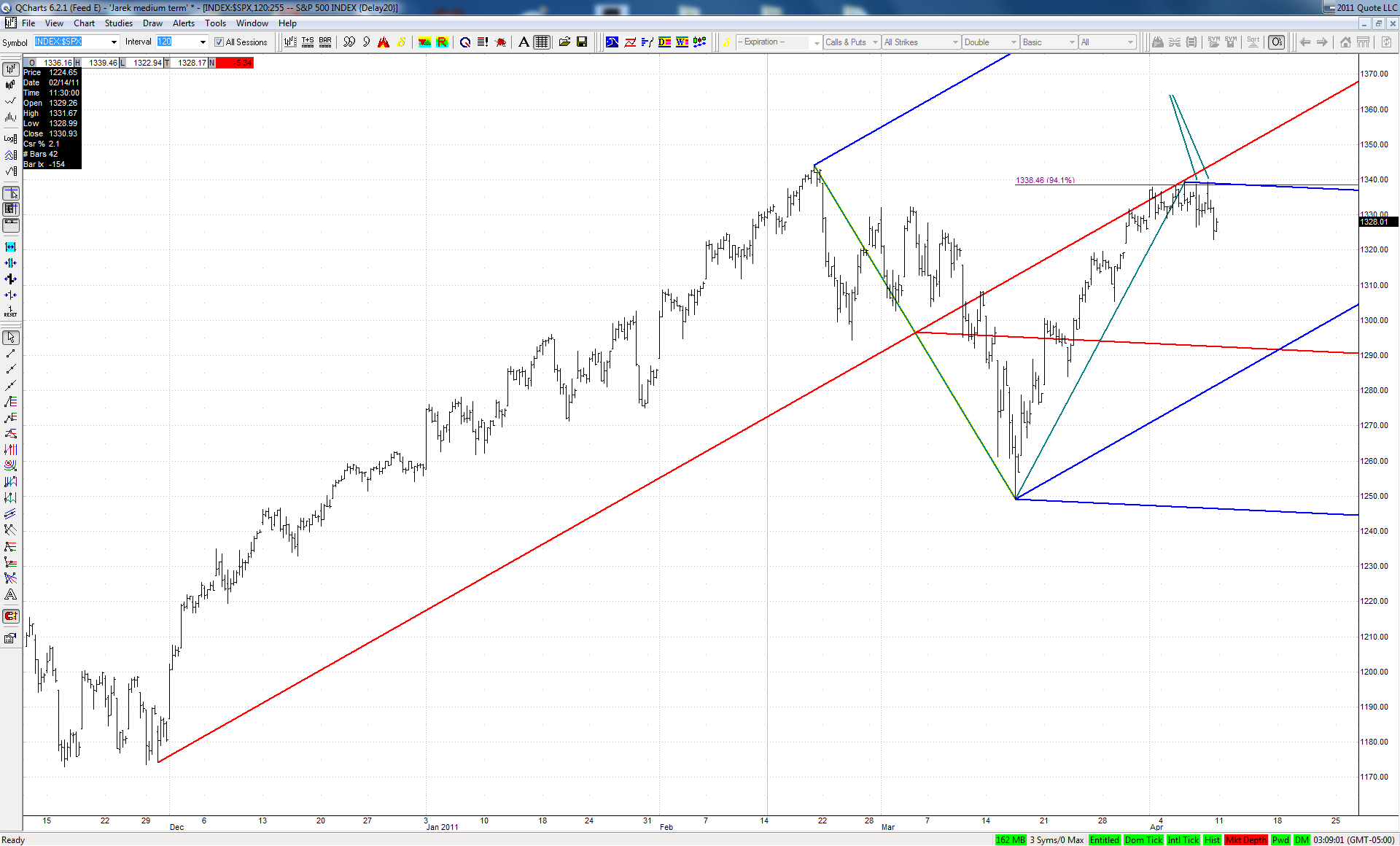
I'm wondering about possible scenarios for a full playout of this test and retest at SPX showed here on Friday:
Click image for original size
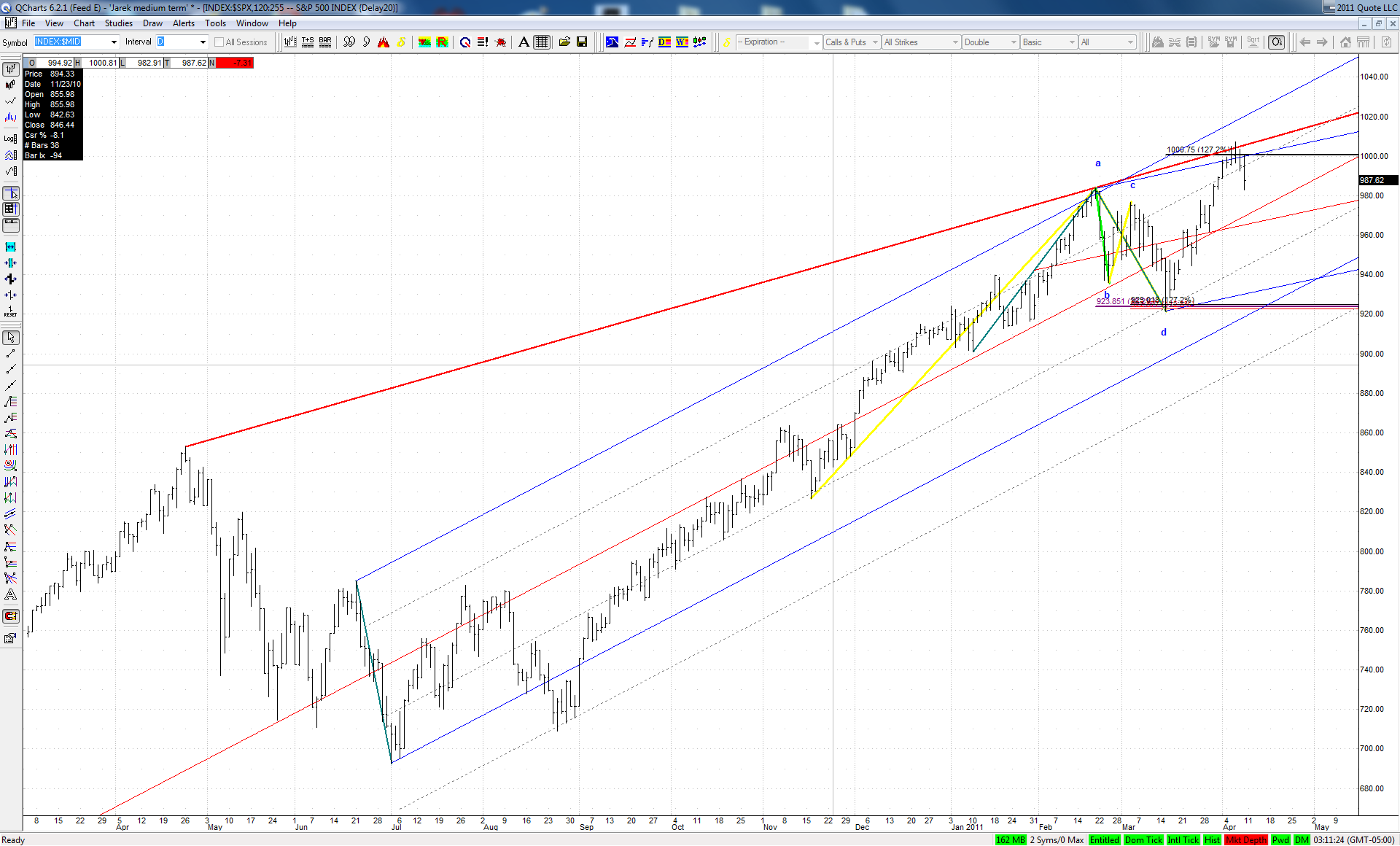
... and the only reason for a quick drop from here to the lower ML could in my opinion be a failed 5th wave at SPX and ES. Because on many other indexes the recent rise looks like already completed 5th wave:
And up off the GZ it goes. Too easy. So predictable. These guys...
JI
jimkane
Rep: 3,058
Posts: 33,089
1
Now watch the small bearish ABCD. Watch it react. Then watch them come in for it at the expected spot. Then watch it go up. Darn, I didn't even get this posted and it did it already...
JI
jimkane
Rep: 3,058
Posts: 33,089
0
But, alas, the ES is rolling over again, and CL, after bouncing a little off the low end of the range, is rolling. That sets CL up for taking out the range low. Now, that may just be a stop sweep and then up, but it sure isn't looking like 'risk on' in any way, shape, or form. Not yet. This may put slight downward pressure on the ES.
JI
jimkane
Rep: 3,058
Posts: 33,089
1
I expect tonight to be fairly exciting. I'll try to post on and off.
TX
tx_ches
Rep: -10
Posts: 514
0
rat89 will have to change his name to roofer2.
Originally posted by jimkane
roofer? Who's roofer? That sounds vaugely familiar, but no, I don't recall no roofer...
Originally posted by rat89
something roofer taught me...
TX
tx_ches
Rep: -10
Posts: 514
0
Asking myself, "would this work 1000 times more often than not" is something I'm trying to ask on the charts that I see posted here and on my own work up. I've got to do better with the probabilities instead of going after the "one-offs".
Originally posted by jimkane
over time and a large series of trades.
JI
jimkane
Rep: 3,058
Posts: 33,089
5
(Edited )
Probability is a strange thing, especially for most people, who are trained to think in absolutes. I find that engineers, doctors, and especially non-probability mathematicians have the most trouble with trading and concepts of probability. I took a course in my college math days on probability and game theory, and although it was totally out of my interest areas (calculus and differential equations), it was by far the most useful course for my trading. I then studied professional poker and other professional gambling management approaches, and that, too, has been immensely helpful.
When one takes a trend trading approach, and say the reward/risk is 3 to 1, then the break even winning % is 25%. Keeping in mind this is an example, without accounting for slippage, commissions, bid/ask spreads, etc., when do I have an 'edge'? Any time the winning percentage is over 25%. How much over? Anything over. Yes, in the real world there is some minimum amount that would be required to make it practical, but it likely isn't very much. Yet people are brainwashed to think 80% is 'good'. It may be highly tradable at 27%, you'd have to crunch the numbers.
At 4 to 1 reward/risk, the B/E is 20% winners. I am looking at things like this when I calculate probabilities. What is the perceived likelihood of the scenario playing out, what is the reward/risk ratio, and hence the expected value of the setup. The long series idea is that anything can happen on any given setup, and one must only look at a statistically significant series before making a decision on changing a 'Trading Plan'. Nothing that happens in one given trade matters.
So, I use the numbers and do some calculations, and decide if there is a positive expected value on the trade. If so, I would consider trading it. I'd have a 'perceived edge'. This would have nothing to do with many of the rules of thumb you hear out there from people who don't understand probability in trading, and expected value calculations. Here are a few that I feel are utterly useless, and plain mathematically unfounded.
- Never trade when the win/loss ratio is less than 50%
- Never trade with an 'inverted' reward/risk i.e. less than 1:1
- A 'good' win/loss ratio is 80%+
- Never trade with less than a 2:1 (or 3:1) reward/risk
All the above are just quicky rules that have less than zero basis in expected value for a given series of trades. I think, and this is just my opinion, one would do well to get things like this out of their brains. It all depends on expected value, which takes into account both win/loss % and reward/risk ratio. That is the calculation that matters, and whether it is positive or negative.
I'll end with an example. Would you be willing to play a game where you lose 99% of the time? Most say no. I say: 'Tell me the reward/risk ratio so I can determine the expected value.' You mean, I may play a game I lose 99% of the time? Heck, yes. I'd play a game I lose 999 out of 1,000 times, if the expected value was positive.
Here it is: we have a 100-sided die (or a number generator, or a hat with 100 marbles in it, 99 of one color and one of another color, however we do it), and when any of the 99 losing numbers come up, you lose $1. When the one winning number comes up, you win $1,000,000. You want to play? I'm in. This has an outrageous positive expectation, yet you 'lose' 99% of the time. The game is also net positive outcome at 99.9% losers, 99.99% losers, 99.999% losers. It doesn't become 'break even' until fractionally over 99.9999% losers. Anything below that, and it's net positive outcome.
So, if someone asks you if you want to play a game where you lose 999,999 times out of a million, ask them what the reward/risk is before you jump right up and say no. Same with trading. You must understand where your edge comes from (the wrong answer is 'the setup'), and it comes from exploiting a net positive outcome expected value for the entire 'Trading Plan', all inclusive.
RA
rat89
Rep: 0
Posts: 7,015
0
no matter how hard I work, no matter what I see....I always am amazed at what roofer saw so clearly that I didn't see....
Originally posted by tx_ches
rat89 will have to change his name to roofer2.
RA
rat89
Rep: 0
Posts: 7,015
3
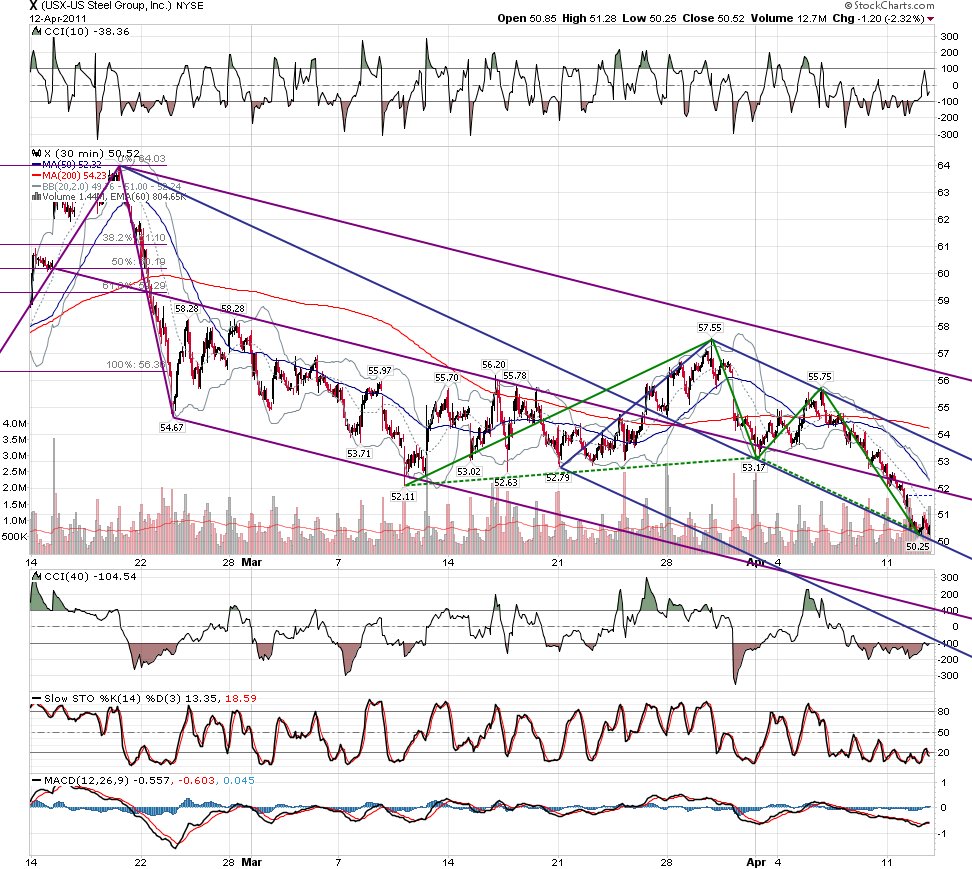
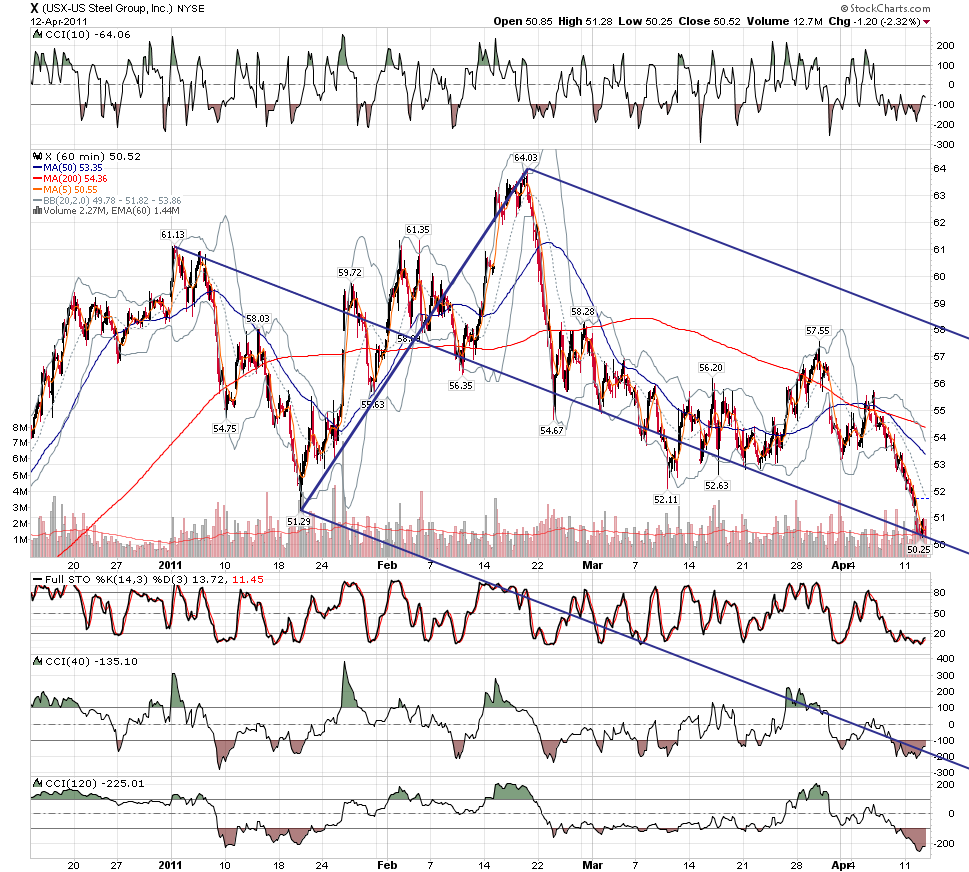
Ok....here's a question....it seems that there are a couple of ways to look at what's happening with x here. The first chart, seems to have pretty much set up in a butterfly, as tx ches pointed out last night. from the 52.11 start point, the b at 53.17 is around the .786 and the d at 1.27 would give you 50.64, with an overrun today..
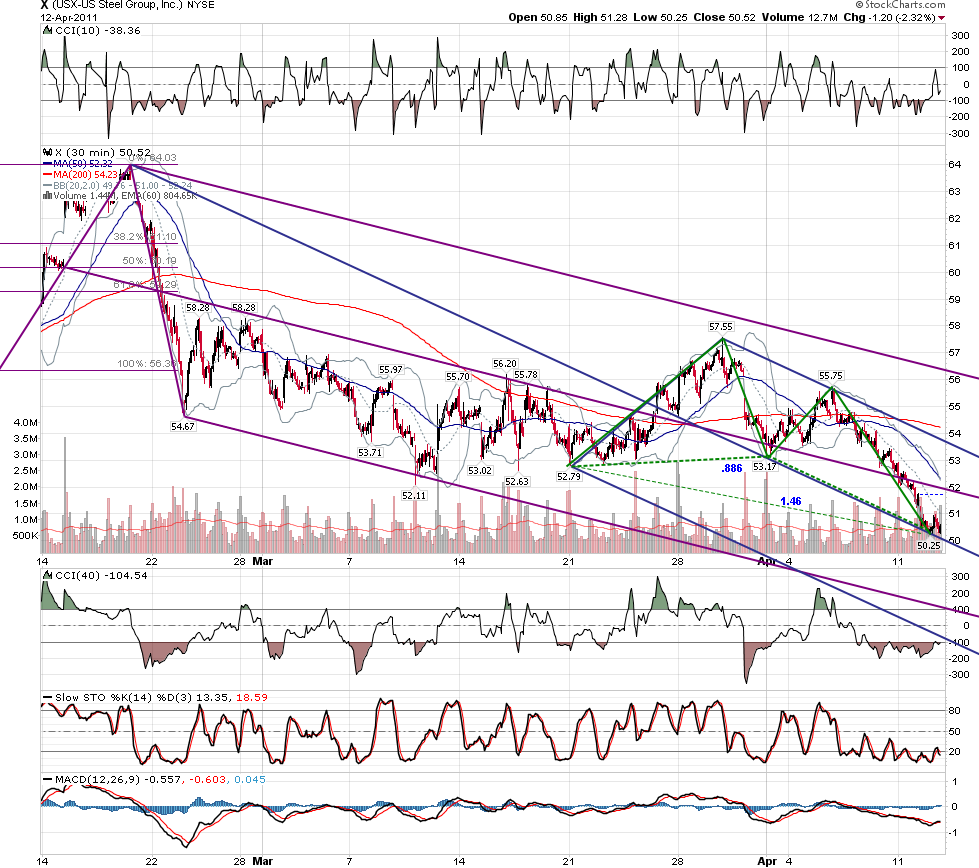
the 2nd chart uses the x point (ha ha) at 52.79, which puts the b point at .886 and the d at an overrun of 1.46 at 50.60
what's interesting is that looking at this dark blue median line set all the points have respected the set. from today's low of 50.25 up to the bounce high at 50.99, assuming no higher high in the am, a 1.27 would put it at 50.05 pretty much right on the median line again.
Obviously, it's out of bounds for a kane pattern, but to what extent could it still be tradeable, and how would you go about it?